.png)
|
In 1948, the Berea Group of Alcoholics Anonymous in Berea, Ohio
[~12.4 mi, ~20.0 km SW of Cleveland], celebrated its 8th anniversary with Clarence S. as the main
speaker
[left: CD recording of his talk]. Its first meeting was on Friday, 23 August 1940, and the group
continues to meet today [right: meeting place, St. Thomas Episcopal Church].
|
.png)
|
10 September 2025
September 10 in A.A. History
09 September 2025
September 9 in A.A. History
.jpg)
In 1925, Melvin “Mel” B. [right, c. WWII] was born in Norfolk, Nebraska, the eldest son and middle child of three
children of Bertha Swisher and Learner B.
One of his schoolmates would be Johnny Carson, the longtime host of The Tonight Show. Mel would sober up in 1950 and become a prolific writer, freelancing for Ohio’s The Toledo Blade and authoring numerous books and articles. Writing as “Mel B.,” he would contribute dozens of articles to the A.A. Grapevine and publish several recovery- and A.A.-related books. Additionally, he would serve as the primary author, without attribution, of Pass It On, the General Service Conference-approved biography of Bill W.
One of his schoolmates would be Johnny Carson, the longtime host of The Tonight Show. Mel would sober up in 1950 and become a prolific writer, freelancing for Ohio’s The Toledo Blade and authoring numerous books and articles. Writing as “Mel B.,” he would contribute dozens of articles to the A.A. Grapevine and publish several recovery- and A.A.-related books. Additionally, he would serve as the primary author, without attribution, of Pass It On, the General Service Conference-approved biography of Bill W.
.jpg)
In 1933, William “Bill” B.
[left, with Lois W.] was born in Brooklyn, New York, the only child of William and Ruth
McLintock B.
He would get sober on 8 Apr 1962; become a close friend of Lois W.’s for the last 16 years of her life; author The Lois Wilson Story: When Love is Not Enough (2005), along with 24 other titles; co-write the screenplay for the movie of the same name (2010); write the screenplay for and act (in the role of “Wade”) in My Name Is Bill W. (1989); produce a number of films, including Dog Day Afternoon, Kansas City Bomber and Serpico; serve as a Stepping Stones volunteer for a half century, and sit on the Stepping Stones Foundation Board of Trustees (1997–2006).
He would get sober on 8 Apr 1962; become a close friend of Lois W.’s for the last 16 years of her life; author The Lois Wilson Story: When Love is Not Enough (2005), along with 24 other titles; co-write the screenplay for the movie of the same name (2010); write the screenplay for and act (in the role of “Wade”) in My Name Is Bill W. (1989); produce a number of films, including Dog Day Afternoon, Kansas City Bomber and Serpico; serve as a Stepping Stones volunteer for a half century, and sit on the Stepping Stones Foundation Board of Trustees (1997–2006).
.jpg)
In 1935, Ernest “Ernie” K. [right] was
born in Rochester, New York—just three months after A.A. was founded. He was
the oldest of two children of Edward and Josephine Kurzejewski
(Koo-zhay-yev’-ski). In 2009, he would reflect back on his surname:
Eight years of grammar school in a German parish shortened that name for practical use, and when I began graduate school bringing transcripts in two names, I was advised to choose one. Tired of too-lengthy phone interactions, I opted for the one that was easier to spell. But I do remain proud of my Polish heritage and advertise it whenever appropriate.
In 1979, Hazelden Educational Services would
publish Ernie’s Not-God: A History of Alcoholics Anonymous, a revised
and expanded version of his 1978 Harvard University dissertation. He would go
on to write at least six more books, along with numerous monographs and
articles on the intellectual significance of A.A., recovery, and
spirituality.
.jpg)
|
In 1936, Lois W.’s father, Dr. Clark Burnham
[left], age 81, or possibly 80, died of pneumonia at Mount Vernon Hospital
in Mount Vernon, New York
[right, New York Times obituary]. He had graduated with honors from Franklin and Marshall College and
studied medicine at the Hahnemann School of Medicine in Pennsylvania,
specializing in gynecology. After his death, the Burnham family home
at 182 Clinton St., Brooklyn, would be taken over by the mortgage
company, allowing Lois and Bill to live there at a reduced rent (due
to rent controls in the depressed housing market) until 1939.
|
%20-%20New%20York%20Times,%20p%2025%20(anonymized).jpg)
|
08 September 2025
September 8 in A.A. History
.jpg)
In 1894, James D. “J.D.” H. [right] was
born in Groves County, Kentucky. He would become A.A. #10 (some sources say #8
or #17) in September 1936 and go on to be a founder of A.A. in Indiana.
07 September 2025
September 7 in A.A. History

In 1939, Lois W. [near right] noted in her
diary that Hank [P.] [far right] remained drunk.
%20of%20Alcoholics%20Anonymous%20(1st%20ed)%20&%20copyright%20page.png)
In 1954, A.A. in the U.K. reprinted the U.S./Canada first edition of the Big Book,
Alcoholics Anonymous, marking the first such reprint outside the
U.S.
[far left: U.K. Big Book 1st edition, 1st printing with dust jacket; near
left: copyright page]. They would later do the same with the U.S./Canada second edition. The
release of the third and fourth editions in the U.K. would coincide with
their release in the U.S./Canada. All four U.K. versions contained the same
stories as the U.S./Canada editions, although there was initial
consideration of including uniquely British stories.
06 September 2025
September 6 in A.A. History
.jpg)
|
In 1939, Lois W. [left, late 1930s?] noted in
her diary, “Hank [P.] [right] drunk, phoned Bill in the afternoon.”
|
.png)
|
05 September 2025
September 5 in A.A. History
In 1907, Nancy F. was born in Philadelphia, Pennsylvania. She would come to A.A. in
New York City in June 1945 at the age of 38, and struggle to stop drinking.
Her story, “The Independent Blonde,” would be published in the second edition
of the Big Book, Alcoholics Anonymous. However, according to her later
account, she was not the author and did not even know her story would appear
in the Big Book.
.jpg)
|
In 1938, [Labor Day] Archie T.
[left] arrived at Dr. Bob and Anne S.’s house
[left: Bob and Anne on their porch] in Akron, Ohio, having had his last drink the day before. Sarah Klein
and her husband had driven Archie down from Detroit. Bob admitted him
to Akron City Hospital that day. Archie would later recall,
|
.jpg)
|
I spent Labor Day in the hospital reading Emmet Fox’s [The] Sermon on the Mount [right]. It changed my entire outlook on life. It changed my direction..png)
.png)
He would stay with the Smiths for 10½ months before moving on to start A.A.
in Detroit, Michigan. His story, “The Man Who Mastered Fear,” appeared in
the first edition of the Big Book, Alcoholics Anonymous, and was
retitled “The Fearful One” in the second and third editions.

In 1939, Lois W. [far left] wrote in her
diary, “Kathleen [P.] [near left],
phoned to say she thought Hank was drunk.”
.png)
In 1947, this is the “official” date of Brazil’s first A.A. group in Rio de Janeiro [right, Brazil with location of Rio de Janeiro marked], established by a tradition during a group meeting on 29 August 1950, around their third anniversary. While no one knows exactly how or when the Rio de Janeiro Group was formed, it is likely that Herbert “Herb” L. Daugherty, a sober American expatriate who had been living there since 1946, played some role in its creation.
.png)
In 1947, this is the “official” date of Brazil’s first A.A. group in Rio de Janeiro [right, Brazil with location of Rio de Janeiro marked], established by a tradition during a group meeting on 29 August 1950, around their third anniversary. While no one knows exactly how or when the Rio de Janeiro Group was formed, it is likely that Herbert “Herb” L. Daugherty, a sober American expatriate who had been living there since 1946, played some role in its creation.
04 September 2025
September 4 in A.A. History
.png)
In 1897, John S. [right: as a young man] was
born in Houlton, Maine, to Rev. Richard and Kate Bolton S.
In the mid-1930s, he would become an oil tanker captain. In 1946, would get sober in Alcoholics Anonymous (A.A.), where he was known as “Captain Jack.” He would play a crucial role in establishing the Loners Internationalists Meeting and its confidential bulletin, a meeting-in-print for “Loners,” “Homers,” “Internationalists,” “Port Contacts” (who serve as contacts for Internationalists visiting their port city), and “Loner Sponsors.” He and hundreds of Internationalists like him, who sailed the seven seas, would carry the A.A. message wherever they dropped anchor, significantly contributing to A.A.’s phenomenal worldwide growth.
In the mid-1930s, he would become an oil tanker captain. In 1946, would get sober in Alcoholics Anonymous (A.A.), where he was known as “Captain Jack.” He would play a crucial role in establishing the Loners Internationalists Meeting and its confidential bulletin, a meeting-in-print for “Loners,” “Homers,” “Internationalists,” “Port Contacts” (who serve as contacts for Internationalists visiting their port city), and “Loner Sponsors.” He and hundreds of Internationalists like him, who sailed the seven seas, would carry the A.A. message wherever they dropped anchor, significantly contributing to A.A.’s phenomenal worldwide growth.
03 September 2025
September 3 in A.A. History
.jpg)
In 1905, Felicia G.
[right, with her mother] was born in Narvosielica, in present-day Ukraine. Her father was a
hard-drinking womanizer with a bankrupt estate in Russian Poland, the
fortune-hunting Polish Count Józef G. Her mother, Eleanor Medill Patterson,
was a Chicago-born newspaper heiress and the granddaughter of Joseph Medill,
founder of The Chicago Tribune.
Felicia would come to Alcoholics Anonymous (A.A.) in 1943, relapse briefly during her first year, and have her last drink in 1944. Marty M. became her sponsor. Her story, “Stars Don’t Fall,” appears in the 2nd and 3rd editions of the Big Book, Alcoholics Anonymous.
Felicia would come to Alcoholics Anonymous (A.A.) in 1943, relapse briefly during her first year, and have her last drink in 1944. Marty M. became her sponsor. Her story, “Stars Don’t Fall,” appears in the 2nd and 3rd editions of the Big Book, Alcoholics Anonymous.
.jpg)
In 1927, after receiving a letter from Frank Shaw of J. K. Rice & Co. inquiring
about rumors of his drinking again, Bill W. replied. He was researching the
Cuban sugar industry
[left: cutting sugar cane on a Cuban plantation]
for Frank while staying at the luxurious Hotel Sevilla in Havana, Cuba. Bill
promised that he and Lois were “going to move to another place which will be
more reasonable and which from now on will answer our purpose just as well.”
However, Lois later recalled that they never left the Sevilla.
Bill’s letter continued:
Bill’s letter continued:
Thank you for your remittance and your letter which followed. Now a few lines for your eyes alone. I have never said anything to you about the liquor question, but now that you mention it and also for the good reason that you are investing your perfectly good money in me, I am at last very happy to say that I have had a final showdown (with myself) on the matter. It has always been a serious handicap to me, so that you appreciate how glad I am to be finally rid of it. It got to the point where I had to decide whether to be a monkey or a man. I know it is going to be a tough job, but nevertheless the best thing I ever did for myself and everybody concerned. That is that, so let us now forget about it.Later, Lois would write that Bill drank the entire time they were in Cuba.

In 1930, after being fired in the fall by his “good friend” Dick Johnson, who had
given him a job in Montreal—mentioned in his Big Book story on p. 4: “Next
morning I telephoned a friend in Montreal…”—Bill W. wrote a pledge to Lois
to stop drinking in the family Bible: “Finally and for a lifetime, thank God
for your love.” This would be the fourth and final pledge he wrote
there [right]. Following this, in
despair, he would refrain from making any further promises, at least in
their Bible.
.jpg)
Something went wrong with my drinking schedule on the 3rd of September, on a Friday* night. Instead of getting drunk in the morning and being asleep in the afternoon and being out and getting drunk in the evening and coming home after Ralph went to bed, I got tangled up somewhere and found myself at home in bed at at [sic] ten o’clock at night and he was home too. The time was drawing near when his family were returning from their vacation and I was going to have to get out of there and incapable of finding myself a room because I couldn’t stay sober long enough to face a perspective [sic] landlady and I had no money with which to pay room rent although in that marvelous alcoholic way, I always had money to drink with. Now don’t ask me to explain that. I lay in bed thinking about approaching him, and thought, “No, he’s been very good to me, he’s done a great deal for me in the past. I don’t want to bother him. I don’t want to bother anybody anymore.”
If I can’t find a solution to this problem by next Monday, this was Labor Day weekend, I’ll put an end to everything. But I finally concluded that before I did anything like that I’d better go in and talk to him. I went in with nothing on
my mind for the solutions to my problems except to ask him if he would lend me $50. He got out of bed, where he’d been reading, and walked up and down the floor and said: “You don’t need $50, you need a great deal more than that.” Well, I agreed with him on that. But he said “You need a new lease on life, a new interest. I can’t give you those things, but I know someone who might. He asked me if I’d be willing to go and talk to this woman [Sarah Klein†]. I knew her very slightly, and I said, “Yes”. Because I would have said yes to anything or anybody who might have some answers for me because I no longer had answers for anything. So he grabbed the telephone and started to make a date for me for the next day and I started to back water [sic]. But it was too late and he made an appointment for me to see this woman the next day.
At four o’clock in the afternoon! [sic] He took me out, bought me some drinks, brought me home, and put me to bed. And I lay there somewhat quieted by the drinks and I wondered how I was going to keep an appointment at four o’clock in the afternoon. And be reasonably sober! And I finally hit on a marvelous solution. I would get up a little earlier than usual and make an effort to get drunk faster. So that I would come home knowing my own habits and sleep off the first of the day’s drinks and then go straight over and see her to keep this appointment. I did these things and they worked out that way.
I don’t know when I had my last drink. It was on Saturday morning on the third of September before Labor Day in 1938. What time of day it was in the morning I don’t know. I blanked out. I got in this car 25 minutes after six. At about half-past seven is the latest my memory serves me. What time I left there and went home and passed out I don’t know. I saw this woman, and to be brief, she offered me a chance to go down to Akron and to meet some men who had found a solution to their problem which was my problem. She offered to take me, she and her husband offered to take me there, and to do it the next day if I were willing to go. She however insisted that I make up my own mind about it, perfectly freely and without any pressure from her. This took me quite a while. I spent a long time in her house sitting there thinking about it.
I finally made the decision. I left her house with the full intention of hurrying as fast as my car would take me to the nearest saloon in getting a drink. Half way [sic] to the saloon something stopped me. I can’t tell you what it was. I know what I think it was. Today I’m sure of what it was. I’m sure that her prayers, which were all that were left to her, to do after she let go of me, that her prayers did that. However, I went home and went to bed after 18 days of continuous drinking I went home and went to bed and sweated it out all night. I don’t need to describe that part of it to you. It makes me shutter [sic] to think of it and it would make all you to [sic] shutter [sic]
.jpg)
†Sarah Klein [right] was known as “The Angel of AA” for her role in helping Archie establish A.A. meetings in Detroit and for her dedication in carrying the A.A. message to alcoholics, particularly n hospitals and prisons.
%20Bean.jpg)
In 1940, The Wichita Beacon (Kansas) published an article
[left] titled “Wichita Will Have
Chapter Of ‘Alcoholics Anonymous.’” An unnamed hospitalized Wichitan said
that “he has contacted numerous of Wichita’s habitual drunkards and during
this week will seek them out to enroll them in the organization.” The article
ended by noting, “In telling the story of the A.A. who began the organization,
the Wichitan illustrated the fundamental help to alcoholics—religion.”

(It was in Wichita, Kansas, on 27 December
1900, that Carry A. Nation [right] first began using a hatchet—rather than the rocks and bricks she had
previously used—against saloons.)
02 September 2025
September 2 in A.A. History

|
In 1977, the three-day 20th International Conference of Young People in
Alcoholics Anonymous (ICYPAA) began at the Shamrock Hilton [left] in Houston, Texas. The theme of the conference was “Sharing
Everyone’s Recovery”
[right: flyer/registration form; below: conference
memorabilia].

|

|
12 June 2024
Supporting A.A. in Ukraine

[Note that this post was written in March 2022, shortly after the full-scale invasion of the Ukraine by the Russian Federation.]
An A.A. friend sent me a very well-done flyer for an online A.A. meeting in Kyiv, Ukraine. It's shown to the left, but I've removed the Meeting ID and Passcode; I don't want to make it that easy to attend. When I first saw it, I thought, "I only wish that we could do something similar for all the Russian alcoholics, who must also be terribly distressed at this time" (especially those in the Russian military).
This flyer was immediately followed by a less well-done message,
shown below, purporting to be from "Ukrainian AA Service Center
and the Ukrainian AA Service Board" to "the AA World Community." I was
skeptical. This looked so much like a myth that I expected to
find it debunked at Snopes
("the internet’s definitive fact-checking
resource"). I did not. But I did find an article titled, "UKRAINE: New Crisis, Grimly Familiar Disinformation Trends", which said, in part,

It is a grim measure of the frequency of crisis events in recent years, and the ubiquity of online disinformation, that when a major story breaks — a terrorist attack, a mass shooting, or an act of war — the writers and editors at Snopes can typically predict what comes next. Recycled videos and photographs, stripped from their proper context, and the same old tropes, all designed to inflame or confuse, or even amuse, the reader.
This is followed by a "grim overview of the familiar disinformation trends and recurring memes… in the opening days of Russia’s invasion of Ukraine."
But, as I said, I only later looked on Snopes. First I searched the Internet. To my surprise, I immediately got a hit that looked very promising. It was on the aa.lviv.ua website and looked like this:

Since I don't know what I presumed was Ukrainian, and not having much patience, I immediately had the page automatically translated into English. It is indeed Ukrainian, and here's the English translation I got:

It was only later that I noticed that an English translation of the message follows the Ukrainian on the original, one click further down. I felt stupid and impatient for not looking.

I tried joining after the meeting was over. It was bedlam. It appeared that most people were unmuted and there were multiple conversations going on at the same time. I saw one man, who appeared to be that single Ukrainian member. He appeared to be quite stressed out. I also saw some A.A.friends of mine, which was disappointing. I only stayed a minute. The last thing they needed at that point was yet one more non-Ukrainian A.A. to join the fray.
Tonight, I learned from a reliable source that only one of the seven or eight regular Ukrainian group members was able to get into the meeting (presumably, the Zoom host). No doubt, many of the attendees had good intentions, although I'm also pretty sure some did not. Clearly, many also didn't think through the consequences of their actions.

25 July 2021
God As We Understand Him?
 I
recently read Bill W.'s essay, “God As We Understand Him: The
Dilemma of No Faith”, in The
Language of the Heart (originally
published as “The
Dilemma of No Faith”
in
the April 1961 issue of the A.A.
Grapevine).
He begins this essay by saying, “The phrase ‛God
As We Understand Him’
is perhaps the most important expression to be found in our whole AA
vocabulary.”
I
recently read Bill W.'s essay, “God As We Understand Him: The
Dilemma of No Faith”, in The
Language of the Heart (originally
published as “The
Dilemma of No Faith”
in
the April 1961 issue of the A.A.
Grapevine).
He begins this essay by saying, “The phrase ‛God
As We Understand Him’
is perhaps the most important expression to be found in our whole AA
vocabulary.”
For a long time, I've been vaguely uncomfortable with this wording, even though I knew what it meant the first time I heard it. In the last few years, but not in my early sobriety, I've sometimes heard newcomers asking about this expression, “How can anyone understand God?” in a way that led me to think that perhaps this was an impediment for them. I realized my discomfort is just that. Perhaps understanding is not the best word. I think “God As We Conceive of God” is closer to the intended meaning. It will be interesting to see how the proposed plain language Big Book* (i.e., Alcoholics Anonymous) will deal with this phrase. If at all.
* If you don't know what this is or what it means, check out Advisory Action #28 (on p 7) in this document: Conference Advisory Actions of the 71st General Service Conference, a list of all such actions adopted at the 71st General Service Conference last April.
17 July 2021
19,560 days
Yes, I am still sober, still above ground. My posts slowed down drastically and then stopped altogether because I feared it would become too easy to identify who I was from my posts, due to circumstances of my life. Already, my brother had figured out this was me. For those who don't realize it, I was doing my best to respect Tradition 12. My brother already knew I was a deeply involved member of A.A.
Future posts will probably be less personal, on the whole. I hope this is, at least in part, because I have less interest in myself and more interest in others [v. Alcoholics Anonymous, p 84].
A.A. in these times of pandemic has been a great experience for me personally. Since mid-March 2020, I've attended online meetings on every continent that has them (Antarctica does not, due to insufficient bandwidth). I've been regularly attending meetings all over the US and Canada, as well as in Australia and South Africa. It has also become much easier to find workshops, conventions, conferences, and meetings that focus on topics like Traditions, Concepts, The A.A. Service Manual, and A.A. history. These are topics that I love learning about. I've been sober almost 29 years, been involved in General Service for 25½ of those years, but I sometimes think I've learned more about General Service in the last 16 months than in all the time before. Maybe not. Maybe it just feels that way.
19 August 2010
Eighteen years

Still here, still sober, even if I'm not posting. Yesterday I celebrated 18 years of continuous sobriety.
19 August 2009
Seventeen years
Yesterday was the 17th anniversary of my first A.A. meeting, which marked the beginning of my current spell of continuous sobriety. I can't say I celebrated, because I was too busy doing things that are little more than the blessings of a sober life:
Apparently not. He was definitely out there. He committed suicide by stabbing himself to death in the parking lot of the apartment complex where he lived. In the femoral artery. Thank you, Bumblebee, for keeping it green for me on my anniversary.
Tonight I will celebrate with dinner and a meeting! Praise HP, from whom all blessings flow!
- Took my car in to have the oil changed and the engine light checked—I not only have a driver's license, I also have a car
- Worked—I am employable today
- Chaired a meeting of the local chapter of a professional organization—not only employed, but on the Board of Directors and also Program Chair
- Attended a funeral
Apparently not. He was definitely out there. He committed suicide by stabbing himself to death in the parking lot of the apartment complex where he lived. In the femoral artery. Thank you, Bumblebee, for keeping it green for me on my anniversary.
Tonight I will celebrate with dinner and a meeting! Praise HP, from whom all blessings flow!
01 April 2009
Is A.A. a religion?
On 17 March 2009, the Commonwealth Court of Pennsylvania issued an opinion in an appeal of the case of Glenside Center, Inc. [a clubhouse hosting meetings of various twelve-step programs] v. Abington Township. A lower court had found that the Glenside Center violated local zoning laws, after the Township received numerous complaints regarding an "adverse parking situation" that "made driving difficult and dangerous and prevented emergency traffic from getting through." There were also complaints about "urinating in public, using obscene language and trash which had been left by members attending meetings." Excessive noise and loitering are also mentioned in the opinion. (Clearly demonstrating the danger of these kinds of totally inappropriate, inconsiderate and non-sober behavior at any A.A. meeting.)
The appeal was on the basis of four issues, namely that the Zoning Board:
Glenside Center is not in any sense A.A. or part of A.A. It is a separately organized enterprise with the [presumable] purpose of providing meeting space for various twelve-step organizations. From the point of view of A.A. groups, it is in no respect different from a church, municipal building or community center providing space for meetings—all these entities are nothing more than landlords.
However, I suspect that all the principals of the Glenside Center are members of A.A. As stated in the opinion, many of those who testified on behalf of the Glenside Center are also members of A.A. One was identified by full name as a member of A.A. for 53 years (you'd think he'd know better after that long). The Center's argument included the following:
Indeed, much of the argument comes down to whether or not there is a difference between spirituality and religion, and what that difference might be. From the American Heritage Dictionary:
1Religious Land Use and Institutionalized Persons Act—a federal statute passed in 2000 to provide stronger protection for religious freedom in the land-use and prison contexts.
2The opinion footnotes this sentence with the following:
4Full quote, from A Conversation with Bill W., A Synopsis of the Question-Answer Period following Bill W.'s talk at the NCCA Syposium in New York in 1960:
The appeal was on the basis of four issues, namely that the Zoning Board:
- had incorrectly found that the use of the building did not meet the requirement of being primarily used as an "office,"
- had denied the clubhouse its rights under RLUIPA1,
- had violated the clubhouse's right to free exercise of religion by determining that the clubhouse was a "Community Center," and
- had failed to prove a compelling governmental interest and had failed to use the least restrictive means to further that interest.
Glenside argues... it is a protected entity under RLUIPA because its activities are a religious exercise.... Glenside argues that AA is not a religion, but its activities and programs constitute a free exercise of religion under RLUIPA. It contends that the 12-step program that AA follows is certainly based upon a belief in a higher power, and various AA members testified that they found a connection with God by attending AA meetings. Glenside directs our attention to a New York Court of Appeals case, Griffin v. Coughlin,... which held that an AA meeting constituted an exercise of religion.Good for the Court, bad for Glenside Center, Inc. Bad, not because they lost their appeal, but for (1) encouraging the courts to consider A.A. a religion, (2) giving the appearance of violating A.A. tradition of having no opinion on outside issues, and (3) for providing a forum for a number of members of A.A. to violate A.A.'s tradition of anonymity at the level of press, radio and film (not to mention on television and on the Internet).
The Board, however, argues and we agree that Glenside presents no binding authority for its proposition that an AA meeting is a religious exercise as that term is used in RLUIPA.2 Glenside failed to prove that any of the meetings are administered by a religious leader, i.e., a minister, priest, rabbi or other spiritual leader. Glenside does not hold any religious services or have any religious affiliations. Its Articles of Incorporation state nothing about being incorporated for a religious purpose, but only to assist people in recovering from addiction. Similarly, Glenside’s printed materials state that Glenside is not a religious organization and do not require that members possess any religious belief to participate. While Glenside argues that members have found a connection with God at its meetings, clearly, the primary purpose of the group meetings, whether they be for AA, NA or DA, is to support individuals who are recovering from alcohol, drug, gambling and debtor addictions, not to advance religion. Particularly where AA and NA meetings are concerned, the primary concern of those meetings is to treat substance abuse. Moreover, Glenside and others on its behalf testified that members come from all religious walks of life whether they be Catholic, Protestant, Jewish, Muslim or non-believers in a higher power. The fact that the 12-step program is used and it contains references to “God” and a “Higher Power” does not mean that all members believe that they are partaking in a religious experience when they are attending an AA or NA meeting.
Glenside Center is not in any sense A.A. or part of A.A. It is a separately organized enterprise with the [presumable] purpose of providing meeting space for various twelve-step organizations. From the point of view of A.A. groups, it is in no respect different from a church, municipal building or community center providing space for meetings—all these entities are nothing more than landlords.
However, I suspect that all the principals of the Glenside Center are members of A.A. As stated in the opinion, many of those who testified on behalf of the Glenside Center are also members of A.A. One was identified by full name as a member of A.A. for 53 years (you'd think he'd know better after that long). The Center's argument included the following:
While AA or its related organizations do not claim to be an established religion, the constituent groups can and have been viewed as engaging in an exercise of religion. The Act broadly defines religious exercise to include "any exercise of religion, whether or not compelled by, or central to, a system of religious beliefs."I became aware of this ruling when a friend in A.A. sent me a link to an entry about it in a Washington Post blog named "Under God." In it, David Waters argues that the Court made a mistake on the basis of four objections. After each objection, I'll give my objections to Mr Waters' objections.
Objection 1: Any person of faith can be a spiritual leader.Actually, I would go even further than Mr Waters. Lack of "a religious leader, i.e., a minister, priest, rabbi or other spiritual leader" should not preclude a gathering from being religious. A prime example would be an unprogrammed meeting for worship of the Religious Society of Friends, commonly known as Quakers.
Objection 2: Assisting people in recovering from any addiction is a religious (and spiritual) purpose.Accepting this argument would make every rehab and detox in the U.S. a religious organization. It would also make seeing any health-care practitioner for help with an addiction into a religious activity.
Objection 3: Any group that advances the healing of bodies and souls (and the forgiveness of debts and debtors) also advances religion.By this argument, entering into any course of psychiatric or psychological therapy, participating in any of numerous self-help organizations or classes, going to see the doctor, going to the gym to work out, or seeking credit counseling would be considered a religious activity. This is patently absurd.
Objection 4: Clearly the court is unaware of the history and purpose of AA.Clearly Mr Waters is not fully aware of the history and purpose of A.A. Let me address each of the facts he cites in support of his objection.
Alcoholics Anonymous was founded as a spiritual program, direct outgrowth of the Oxford Group at Calvary Episcopal Church in New York.True. But it's also true that the Oxford Group (known since 2001 as Initiatives of Change) considered itself non-religious. Furthermore A.A. separated from the Oxford Group at least in part due to the latter's belief that alcoholism was a sin rather than a disease, and to sever what might appear as ties to a Christian organization.
AA meetings include recitations of The Lord's Prayer and the Serenity Prayer.Actually, this seems to me to be a reasonably good argument. It's one reason I do not participate in saying the Lord's Prayer at meetings. Not all meetings use the Lord's Prayer, though I'd have to say that most in the U.S.3 do. As for the Serenity Prayer, so far as I know, it is not perceived to be associated with Christianity, despite its purported author being a Christian theologian. As insightful as it may be to us drunks, the idea would seem to be quite universal in thought and application among those who consider and practice such things. Indeed, the essential idea can be found in a Mother Goose rhyme:
- For every ailment under the sun
- There is a remedy, or there is none;
- If there be one, try to find it;
- If there be none, never mind it.
"AA indirectly derived much of its inspiration from the Church," Rev. Samuel M. Shoemaker, Rector of Calvary Church, said in 1955.Key word: indirectly. I'd say that a huge number of institutions of Western civilization were indirectly derived from Christianity, not the least of which is the United States of America. Furthermore, citing a single person—a non-A.A. member at that—saying this in a single speech is not much of an argument. Bill W., co-founder of A.A. and a much better source to cite, said of the phrase God as we understood him that it was "tremendously important," "a ten-strike," enabling "thousands to join AA who would have otherwise gone away," opening the door to "those of fine religious training and those of none at all," making "one’s religion the business of the AA member himself and not that of his society."4
Newcomers to A.A. are commonly encourage to find a power greater than themselves even if that power is nothing more than a doorknob or an ashtray. Many A.A. members attain long-term sobriety using A.A. itself as a higher power (God is sometimes identified as an acronym, standing for "Group of Drunks"). Even casual acquaintance with A.A.'s program makes it clear that this higher power can be of whatever conception one so chooses. See also the quote of Bill W.'s referred to above.AA's Twelve Traditions includes No. 2: "For our group purpose there is but one ultimate authority -- a loving God as He may express Himself in our group conscience." Seven of AA's famous Twelve Steps reference God, including:
- 2. Came to believe that a Power greater than ourselves could restore us to sanity.
- 3. Made a decision to turn our will and our lives over to the care of God as we understood Him.
- 11. Sought through prayer and meditation to improve our conscious contact with God as we understood Him, praying only for knowledge of His will for us and the power to carry that out.
- 12. Having had a spiritual awakening as the result of these steps, we tried to carry this message to alcoholics and to practice these principles in all our affairs.
"Would that the Church were like this," Shoemaker said in 1955, "ordinary men and women with great need who have found a great Answer, and do not hesitate to make it known wherever they can - a trained army of enthusiastic, humble, human workers whose efforts make life a different thing for other people!"Is Mr Waters saying that a non-religious group of people cannot exhibit these same characteristics? I suspect that any number of political activists would be happy with such a description.
If a group that meets under spiritual precepts, performs rituals, and seeks to heal its members isn't religious, what else is it?Rituals? To what rituals does Mr Waters refer? He hasn't mentioned any up to this point in the article and doesn't mention any after this either. And without rituals, all that's left is a group that uses spiritual precepts and seeks to heal its members. In at least one sense of the word spiritual, a vast number of groups satisfy this description.
Indeed, much of the argument comes down to whether or not there is a difference between spirituality and religion, and what that difference might be. From the American Heritage Dictionary:
spir·i·tu·alAs will be clear to anyone who is familiar with A.A. and its program of recovery, A.A. itself would not accept any definition other than one with the broadest possible meaning. The meaning of A.A. being a spiritual program could be that it is religious to the member who is herself religious. That meaning could be only that it is intangible or immaterial to the member who is himself not religious. A.A. itself doesn't care. A.A. is areligious.
ADJECTIVE:1. Of, relating to, consisting of, or having the nature of spirit; not tangible or material. See synonyms at immaterial. 2. Of, concerned with, or affecting the soul. 3. Of, from, or relating to God; deific. 4. Of or belonging to a church or religion; sacred. 5. Relating to or having the nature of spirits or a spirit; supernatural.
1Religious Land Use and Institutionalized Persons Act—a federal statute passed in 2000 to provide stronger protection for religious freedom in the land-use and prison contexts.
2The opinion footnotes this sentence with the following:
RLUIPA defines “Religious exercise” as follows:3I know from personal experience that the Lord's Prayer is rarely used in Australia, and that because of this Australian members of A.A. pride themselves on being more consistent with A.A. principles than A.A. in the U.S. is.
(A) In general. The term “religious exercise” includes any exercise of religion, whether or not compelled by, or central to, a system of religious belief.
(B) Rule. The use, building, or conversion of real property for the purpose of religious exercise shall be considered to be religious exercise of the person or entity that uses or intends to use the property for that purpose.
4Full quote, from A Conversation with Bill W., A Synopsis of the Question-Answer Period following Bill W.'s talk at the NCCA Syposium in New York in 1960:
When these Steps were shown to my friends, their reactions were mixed indeed. Some argued that six steps had worked fine, so why twelve? From our agnostic contingent there were loud cries of too much “God.” Others objected to an expression which I had included which suggested getting on one’s knees while in prayer. I heavily resisted these objections for months. But I finally did my statement about a suitable prayerful posture and finally went along with that now tremendously important expression, “God as we understand Him” — this expression having been coined, I think, by one of our former atheist members. This was indeed a ten-strike. That one has since enabled thousands to join AA who would have otherwise gone away. It enabled people of fine religious training and those of none at all to associate freely and to work together. It made one’s religion the business of the AA member himself and not that of his society.
12 December 2008
Still above ground and sober
For anyone who's wondering, I'm doing okay. I got elected to another Area office and expect to continue in General Service for another two years. Nimue is divorcing me after nearly three years of separation. Despite that, I feel as good as I have in a long time. Despite some heavy bouts of depression over the last nine months, I recently thought to myself, "Ah, so this is what it feels like not to be depressed! I had forgotten."
Despite the fact that I haven't posted for over nine months, every now and then, someone adds a comment to an old post. This, if nothing else, sporadically reminds me that I'd like to taking up at least semi-regular posting again. Absolutely no promises, we'll see.
Despite the fact that I haven't posted for over nine months, every now and then, someone adds a comment to an old post. This, if nothing else, sporadically reminds me that I'd like to taking up at least semi-regular posting again. Absolutely no promises, we'll see.
04 March 2008
Today's reflection
The entry for March 4th in Daily Reflections has long been among my favorites:
I am a product of God's grace and mercy. Of his grace, because I got something I didn't deserve; of his mercy, because I didn't get what I did deserve.
The Bill W. quote inspires me, and the garden metaphor is beautiful and accurate. It describes where I am, where I have mostly been for quite some time.The essence of all growth is a willingness to make a change for the better and then an unremitting willingness to shoulder whatever responsibility this entails. AS BILL SEES IT, p. 115By the time I had reached Step Three I had been freed of my dependence on alcohol, but bitter experience has shown me that continuous sobriety requires continuous effort. Every now and then I pause to take a good look at my progress. More and more of my garden is weeded each time I look, but each time I also find new weeds sprouting where I thought I had made my final pass with the blade. As I head back to get the newly sprouted weed (it’s easier when they are young), I take a moment to admire how lush the growing vegetables and flowers are, and my labors are rewarded. My sobriety grows and bears fruit.
I am a product of God's grace and mercy. Of his grace, because I got something I didn't deserve; of his mercy, because I didn't get what I did deserve.
27 February 2008
Bad language in meetings
The groups in one of the Districts in our Area are having trouble finding locations in which to meet. They've been kicked out of certain churches and the word seems to be spreading among those churches that we're not very good tenants. The two primary issues are (a) too much bad language and (b) smokers congregating around the entrances and leaving butts lying around.
My home group has a requests in our format bearing on these issues and we have [usually] dealt with abuses as they come up. It's something I highly suggest that other groups consider with regard to what their group conscience should be. Every time I hear someone using language generally considered impolite I shudder, imagining some pillar of the church congregation passing by in the hallway at that moment and overhearing us. Personally I have little objection to people using whatever language they wish, but I also think it's important that many people do take offense at such language and that we need to be especially wary with regard to our landlords.
Not too long ago I heard something that covers my feelings on this subject very well:
My home group has a requests in our format bearing on these issues and we have [usually] dealt with abuses as they come up. It's something I highly suggest that other groups consider with regard to what their group conscience should be. Every time I hear someone using language generally considered impolite I shudder, imagining some pillar of the church congregation passing by in the hallway at that moment and overhearing us. Personally I have little objection to people using whatever language they wish, but I also think it's important that many people do take offense at such language and that we need to be especially wary with regard to our landlords.
Not too long ago I heard something that covers my feelings on this subject very well:
The absence of profanity offends no one.
10 January 2008
Studying the steps as laid out in the Big Book
 IMNSHO, there's no way to become familiar with the program of Alcoholics Anonymous like doing a study of the Big Book, paragraph by paragraph, in a group, with plenty of time to comment and discuss with each other.
Tuesday night my sponsor, in his home, started [what I think is] the fourth such annual study group. Most years, including this year, we use what I recently learned is the Hyannis rotation to determine which pages in the Big Book to read for which steps. It comprises "The Doctor's Opinion" and chapters 3 ("More About Alcoholism"), 4 ("We Agnostics"), 5 ("How It Works"), 6 ("Into Action") and 7 ("Working with Others"). While not specified we usually read Appendix II ("Spiritual Experience"), which of course was added after the first printing of the first edition to clarify that not every alcoholic need have a as vivid an experience as Bill W. had in order to recover. Last year we also used Twelve Steps and Twelve Traditions.
It was originally my suggestion that we follow the Hyannis rotation. I knew about it because of a regular Big Book Step Study group that I attend whenever I can. At that group's meeting, we read a page at a time rather than a paragraph at a time, but the discussion generally stays focused on the step being studied and is usually quite excellent. I've learned a tremendous amount there.
That Big Book Step Study group was started about a dozen years ago and originally used the chairperson's guidelines (somewhat loosely I believe—I only started attending later) and the Hyannis Preamble, modified so that only those who had worked all twelve steps could share. Early on, by group conscience, they abandoned that requirement, as well as the one in the Hyannis Preamble that only those who had worked the step being studied could share.
So far as I know this group was never—and is still not—listed in the Hyannis directory of "official" Big Book Step Study meetings. I'm just as glad. The idea of putting an "official" seal of approval on any group disturbs me. I'm not exactly sure why, though the first—and, so far, only—thought that comes to mind is that it may violate the Third Tradition: an A.A. group can have no other affiliation than that with A.A. itself.
P.S. On an entirely unrelated note, the fortune cookie that came with my Thai lunch said, "You are the master of every situation." Ha!
07 January 2008
I'm baaaack
Well, that took longer than I had expected. LOL! I'm not sure what "that" was, but I never intended to go almost six weeks without posting. I appreciate all the people who checked in with me to make sure I was okay.
Several things happened. First, in early December, I was consumed with preparing for a meeting of the Area Committee. Next I had to get my affairs in order because I was leaving town in mid-December. Then I actually left town, traveling across the continent for Christmas with my four grandchildren (and daughter S-Cat and her husband Revson). Finally, after my return, I had some trouble adjusting to my normal life again. I hope I'm now back in stride.
Late in November I started up on a new med. I'm still not quite sure how I'm doing. At worst, the nature of my depression has changed from being angry and pissed off all the time to merely having trouble getting out of bed every day—part of what I meant above by "trouble adjusting to my normal life." At best, I'm doing much better and the difficulty getting going has been due to jet lag, not having any work and my natural laziness. I need to check in with my therapist and I'll be seeing my primary care guy late in the month. I am having some other physical symptoms that may or may not be due to the sertraline: muscle clenching, some congestion and a mild cough.
 The congestion and mild cough may be something I picked up from my grandchildren. In any case, I sure enjoyed it. It wasn't exactly relaxing and I didn't get a lot of sleep—the four grandchildren are all age 6 and under. I slept in the living room and the oldest got up like clockwork at 6:15 AM every morning. He made sure I got up then too, usually by coming in and jumping on top of me. It's been many years since I spent Christmas morning with small children and that was a real delight. The four of them got a huge pile of presents. I worry that they're going to be spoiled, but I didn't hesitate in contributing to that, hehehe.
 My son-in-law Revson and I spent the afternoon of the day after Christmas fishing the with two older grandchildren. What a blast! The two of us started off by hooking the fish—spotted bay bass, and we were catching and releasing—then passing the rods to the two kids. But we had three rods, so the oldest grandchild started hooking and catching his own. In the end the two of them pulled in well over a dozen fish. He got a few more than she did, but she got the biggest one of the day, so everyone was happy.
Revson has started attending A.A. since I last visited so I got to attend more than my usual number of A.A. meetings. That was a real treat; I met some wonderful people. There were a number of things I noticed about A.A. there that are different from A.A. here. (1) We have anniversaries: e.g. 30-, 60-, 90-day ones as well as yearly ones; they have yearly "birthdays" (and actually sing "Happy Birthday"), while milestones of less than a year are "special occasions". (2) When reading "How It Works", they recite in unison, "God could and would if he were sought"; here, we don't. (3) Their chants after closing (generally with the Lord's Prayer, just like we do) are longer and more enthusiastic than ours are.
I heard early on that the single most common thing that alcoholics communicate with GSO in New York about is a complaint along the lines of "I just moved to this part of the country from somewhere and they don't do A.A. right here!" One time when I visited GSO I asked if this was true. Turns out that it is. I can't help observing that while A.A. does seem to be practiced slightly differently in different parts of the world, people everywhere seem to be able to stay sober. And that's all that really counts, isn't it?
Several things happened. First, in early December, I was consumed with preparing for a meeting of the Area Committee. Next I had to get my affairs in order because I was leaving town in mid-December. Then I actually left town, traveling across the continent for Christmas with my four grandchildren (and daughter S-Cat and her husband Revson). Finally, after my return, I had some trouble adjusting to my normal life again. I hope I'm now back in stride.
Late in November I started up on a new med. I'm still not quite sure how I'm doing. At worst, the nature of my depression has changed from being angry and pissed off all the time to merely having trouble getting out of bed every day—part of what I meant above by "trouble adjusting to my normal life." At best, I'm doing much better and the difficulty getting going has been due to jet lag, not having any work and my natural laziness. I need to check in with my therapist and I'll be seeing my primary care guy late in the month. I am having some other physical symptoms that may or may not be due to the sertraline: muscle clenching, some congestion and a mild cough.
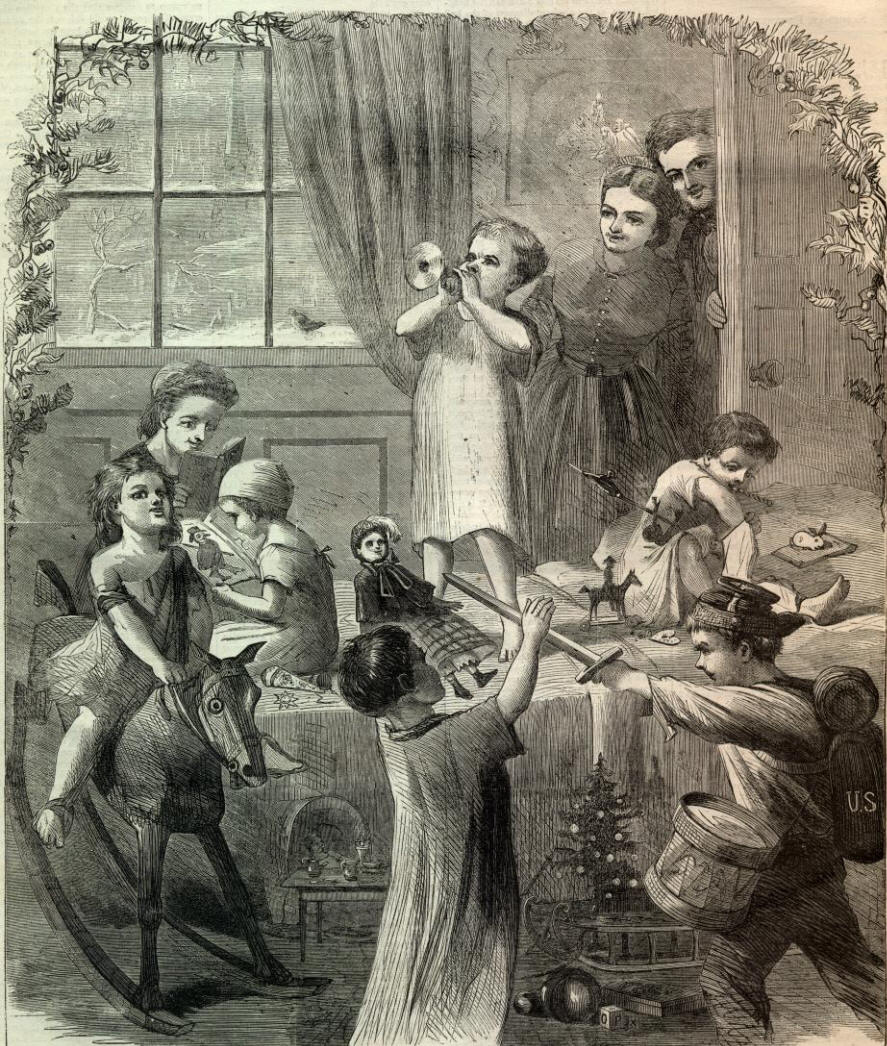 The congestion and mild cough may be something I picked up from my grandchildren. In any case, I sure enjoyed it. It wasn't exactly relaxing and I didn't get a lot of sleep—the four grandchildren are all age 6 and under. I slept in the living room and the oldest got up like clockwork at 6:15 AM every morning. He made sure I got up then too, usually by coming in and jumping on top of me. It's been many years since I spent Christmas morning with small children and that was a real delight. The four of them got a huge pile of presents. I worry that they're going to be spoiled, but I didn't hesitate in contributing to that, hehehe.My son-in-law Revson and I spent the afternoon of the day after Christmas fishing the with two older grandchildren. What a blast! The two of us started off by hooking the fish—spotted bay bass, and we were catching and releasing—then passing the rods to the two kids. But we had three rods, so the oldest grandchild started hooking and catching his own. In the end the two of them pulled in well over a dozen fish. He got a few more than she did, but she got the biggest one of the day, so everyone was happy.
Revson has started attending A.A. since I last visited so I got to attend more than my usual number of A.A. meetings. That was a real treat; I met some wonderful people. There were a number of things I noticed about A.A. there that are different from A.A. here. (1) We have anniversaries: e.g. 30-, 60-, 90-day ones as well as yearly ones; they have yearly "birthdays" (and actually sing "Happy Birthday"), while milestones of less than a year are "special occasions". (2) When reading "How It Works", they recite in unison, "God could and would if he were sought"; here, we don't. (3) Their chants after closing (generally with the Lord's Prayer, just like we do) are longer and more enthusiastic than ours are.
I heard early on that the single most common thing that alcoholics communicate with GSO in New York about is a complaint along the lines of "I just moved to this part of the country from somewhere and they don't do A.A. right here!" One time when I visited GSO I asked if this was true. Turns out that it is. I can't help observing that while A.A. does seem to be practiced slightly differently in different parts of the world, people everywhere seem to be able to stay sober. And that's all that really counts, isn't it?
Subscribe to:
Posts (Atom)


