27 June 2025
June 27 in A.A. History
26 June 2025
June 26 in A.A. History
On June 26, 1935, I came to in the hospital, and to say I was discouraged is to put it mildly. Each of the seven times I had left this hospital in the previous six months, I had come fully determined in my own mind that I would not get drunk again—for at least six to eight months. It hadn’t worked out that way, and I didn’t know what the matter was and did not know what to doTwo days later, Bill W. and Dr. Bob S. came to see him. Six days after that, he left the hospital, never to drink again. That day, July 4, marked the founding of A.A. Group Number One. Within a week, he was back in court, arguing a case.
Today in A.A. History—June 26–29
- The… plan for selecting Class B Trustees from outlying areas is submitted for consideration, subject to approval of the General Service Conference [note: this is the first move to establish Regions—the initial geographical groupings were called “Area A” thru “Area E”].
- The Delegates voted overwhelmingly to set the retail price of the new edition [of Alcoholics Anonymous] at $4.50 [~$54 in 2025], the price to A.A. groups at $4.00 [~$48 in 2025] and to earmark fifty cents [of each sale] for the Reserve Fund.
- … adopting the proposed permanent “Charter of the General Service Conference of Alcoholics Anonymous—North American Section,” subject to approval of the 20th Anniversary Convention of A.A.
- Headquarters cooperation with the North American Newspaper Alliance syndicate, with Fawcett Publications and with the New York Daily News on stories proposed. In all cases, emphasis is on the fact that A.A. does not “promote” publicity, nor does it endorse specific articles.
- Headquarters cooperation in John Daly’s network television presentation on A.A. on his “Open Hearing” program. Substantial assistance was rendered by Grapevine personnel.
- Continued correspondence and consultation with representatives of Metro-Goldwyn-Mayer studios over the projected filming of the Lillian Roth book, “I'll Cry Tomorrow,” in which it is proposed to portray an A.A. member who deliberately breaks anonymity.
25 June 2025
June 25 in A.A. History
In 1939, Percy Hutchison of The New York Times gave a highly favorable review [right] of the book Alcoholics Anonymous. He noted that its central thesis “is more soundly based psychologically than any other treatment of the subject I have ever come upon.” However, despite the positive review, sales did not improve, as the book was not available in bookstores.
24 June 2025
June 24 in A.A. History
As a salesman, Irv traveled extensively throughout the southeastern United States, selling Venetian blinds. During his travels, he started A.A. meetings and became a highly effective high-pressure salesman, with both alcoholics and his customers. In Alcoholics Anonymous Comes of Age, Bill W. would note:
Irwin weighed 250 pounds [~113.4 kg], at 5’9” [175 cm] tall] and was full of energy and gusto. The prospect of Irwin, as a missionary, scared us rather badly.
Due to his vast sales territory, Irv regularly received lists of potential A.A. members from Ruth Hock at the Alcoholic Foundation Headquarters in New York City. He pursued these leads with the same enthusiasm he applied to his sales efforts, establishing A.A. groups in cities such as Atlanta, Georgia; Indianapolis, Indiana; West Virginia; and throughout the South.
In 1938, Frank Amos [near right] wrote to Albert Scott [far right] (both close associates of John D. Rockefeller, Jr)…
to tell you in detail the developments in the activities of the self-styled Alcoholics squad… The work has been going splendidly and every day evidences are piling up which strengthen my conviction that these fellows are not only on the level but have developed a Christian technique which if earnestly followed out is, and can be, effective in a majority of cases… [T]hey have decided to bring out a book.… The idea is for the book not to bear the name of any author but to be by “Alcoholics Anonymous.”
a rough draft of the first dictation. The first page… is outlining the purpose of it. The rest is a rough beginning on Chapter I [“There Is A Solution”] and on the first story of an ex-alcoholic [“Bill’s Story”].
|
In 1985, U.S. President Ronald Reagan
[left] sent a two-page letter of congratulations to Alcoholics Anonymous in recognition of its 50th Anniversary
celebration, which would take place during the International
Convention in Montreal from July 5 to 7. The letter
[right] stated, in part:
|
|
Nancy and I send our warmest wishes for a successful convention as you continue to observe the 50th anniversary of Alcoholics Anonymous. Look around you, at the more than 30,000 men, women, and even children who have overcome alcoholism. You are the lucky ones; you are the winners.…
I would like to share with you one of Nancy’s favorite stories. It is about a starfish man.
One morning at dawn, a young boy went for a walk on the beach. Up ahead, he noticed an old man stooping down to pick up starfish and flinging them into the sea. Finally, catching up with the old man, the boy asked him what he was doing. The old man answered that the stranded starfish would die unless they were returned to the water.
“But the beach goes on for miles, and there are millions of starfish,” protested the boy. “How can what you’re doing make any difference?”
The old man looked at the starfish in his hand and then threw it to safety in the waves. “It makes a difference to this one,” he said.
When the co-founders of AA first began to share their hope, they had no idea that AA would become more than one million members strong, or that it would encompass 114 countries around the world. But they laid the foundation for the world's largest self-help group. They reached for only one stranded starfish at a time… one day at a time.
You are making the world a better place for all of us, and on behalf of all mankind, we are grateful. God bless all of you.
22 June 2025
June 22 in A.A. History
The famous 12-step program for stopping an addiction has sold more than 30 million copies. Millions of men and women worldwide have turned to the program co-founded by Bill W[—] and Dr. Bob S[—] to recover from alcoholism. The "Big Book," as it is known, spawned similar programs for other forms of addiction. Shown here is the third edition. The book is now in its fourth edition.
June 21 in A.A. History
I have not read [it] intently, but such extracts as I have had opportunity to read prove the document a very interesting one and I shall take the opportunity to read it more at more length.… On my return from the Bankers Convention,…I will try to work out an appointment with you.
A one-year subscription cost $1.50 [~$27.40 in 2025], resulting in 165 subscriptions. Six volunteers, whom Bill W. referred to as “six ink-stained wretches,” launched it as an 8-page newsletter for members in the New York City area and for GIs overseas.
Note: all square brackets ([ ]) are from the original, except for “[sic]”.
June 20 in A.A. History
After Dr. Saul’s death in 1947, Dr. Davis moved the clinic to Malvern, Pennsylvania, renaming it the Malvern Institute [right, 2017]. Both doctors were early advocates of Alcoholics Anonymous (A.A.) and traveled together to promote the organization, believing in the benefits of a 12-step program for recovering alcoholics.
Additionally, Dr. Saul founded the 4021 Clubhouse [left, 1972] in Philadelphia for A.A. meetings, which remains active today.
19 June 2025
June 19 in A.A. History
Today in A.A. History—June 19–21
18 June 2025
June 18 in A.A. History
Although he missed the chance to become A.A. #3 himself, years later, at a large A.A. meeting in Youngstown, Dr. Bob exclaimed, “Holy Moses!” upon seeing Eddie, who was reportedly sober for one year at that time. Eddie attended Dr. Bob’s funeral in 1950 and later became a member of the Youngstown, Ohio group. When Eddie died in 1963, his wife said he had been sober for 17 years, dating back to 1946.
|
|
In 1940, the first meeting at the original A.A. clubhouse, located at 334½
W. 24th St. in New York City, was attended by 100 people. A February
1951 article in the A.A. Grapevine would say about this location:The cryptic letters “AA” had gone up on a battered green doorway in the undistinguished neighborhood of New York’s once elegant Chelsea district. It isn’t a very auspicious doorway, nor a conspicuous sign.… Wedged in between two old-fashioned brick-fronts,… there isn’t supposed to be any doorway there at all.… You push open the door. You’re in a little vestibule.… And you open the inner door to find—nothing! Nothing, that is, except a long, bare, tunnel-like and mysterious looking hallway.… Actually this is merely the passageway between the two houses back to the oddity of an “extra building” built in the rear, over what had once been the “gardens.” It was Bill who first christened this hall “The Last Mile.”… Ultimately you step into the inner sanctum which… is the “meeting room.” An old upright piano, a card table or two, a few nondescript chairs and, of course, people. But the center of the room to your newcomer’s eye is the fireplace, pine panelled [sic], with a plain wooden mantel and, over it… the sign reading—“But For The Grace of God….” On the second floor there is another room of about the same size only somewhat lighter and airier because of the skylight. Here, in addition to the secretary’s desk, is what is called… grandly… “the lounge” … two wicker divans, three chairs and a table! Off in the far corner is a door leading to two tiny rooms that will be Lois and Bill’s living quarters during a period when AA’s financial affairs could easily be kept on the back of an old envelope.Herbert “Bert” T. and Horace C. personally guarantee rent for the building. [Above left, top to bottom: climbing the the stairs behind the entrance; main room of clubhouse. Above right, top to bottom: entrance; the “long, bare tunnel-like and mysterious” hallway; the upstairs room, where Bill and Lois lived for the first year the clubhouse was open. Below: The Saturday Evening Post’s photo of “a typical meeting,” which was anything but typical.] |
|
17 June 2025
June 17 in A.A. History
Bill and Lois had interrupted their motorcycle tour in Alabama to attend the wedding. On their way, they had an accident outside Dayton, Tennessee, where Bill broke his collarbone and Lois twisted her leg, resulting in “water on the knee.” They spent a week recovering and then, after a few more days, shipped their motorcycle and belongings home while they took the train. As Lois described it:
Although we were in plenty of time for the wedding, I made a sorry looking matron of honor, when, with red gashes on my face, I limped up the aisle.
Dr. Bob had decided to attend the annual American Medical Association convention in Atlantic City, New Jersey, from June 10 to 14. During the trip, he engaged in several days of binge drinking: on the way to the convention, during the convention, and while returning home. Ultimately, a drunken Dr. Bob ended up at the home of his office nurse in Cuyahoga Falls, Ohio. His wife, Anne [near right], and Bill W. [far right] came to pick him up. With Bill’s help, Bob spent three days sobering up. Facing surgery at Akron City Hospital, he made a pivotal decision:
I am going through with this—I have placed both the operation and myself in God’s hands. I’m going to do what it takes to get sober and stay that way.Before the surgery, Bill gave Bob his last drink, a beer, along with a “goofball” (a barbiturate) to help steady him.
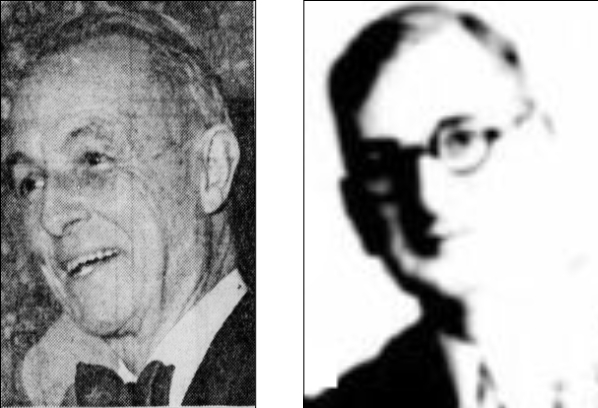
| In 1967, T. Henry Williams [left] died and was buried at Crown Hill Cemetery and Mausoleum in Twinsburg, Ohio. |
12 June 2024
Supporting A.A. in Ukraine
[Note that this post was written in March 2022, shortly after the full-scale invasion of the Ukraine by the Russian Federation.]
An A.A. friend sent me a very well-done flyer for an online A.A. meeting in Kyiv, Ukraine. It's shown to the left, but I've removed the Meeting ID and Passcode; I don't want to make it that easy to attend. When I first saw it, I thought, "I only wish that we could do something similar for all the Russian alcoholics, who must also be terribly distressed at this time" (especially those in the Russian military).
This flyer was immediately followed by a less well-done message,
shown below, purporting to be from "Ukrainian AA Service Center
and the Ukrainian AA Service Board" to "the AA World Community." I was
skeptical. This looked so much like a myth that I expected to
find it debunked at Snopes
("the internet’s definitive fact-checking
resource"). I did not. But I did find an article titled, "UKRAINE: New Crisis, Grimly Familiar Disinformation Trends", which said, in part,
It is a grim measure of the frequency of crisis events in recent years, and the ubiquity of online disinformation, that when a major story breaks — a terrorist attack, a mass shooting, or an act of war — the writers and editors at Snopes can typically predict what comes next. Recycled videos and photographs, stripped from their proper context, and the same old tropes, all designed to inflame or confuse, or even amuse, the reader.
This is followed by a "grim overview of the familiar disinformation trends and recurring memes… in the opening days of Russia’s invasion of Ukraine."
But, as I said, I only later looked on Snopes. First I searched the Internet. To my surprise, I immediately got a hit that looked very promising. It was on the aa.lviv.ua website and looked like this:
Since I don't know what I presumed was Ukrainian, and not having much patience, I immediately had the page automatically translated into English. It is indeed Ukrainian, and here's the English translation I got:
It was only later that I noticed that an English translation of the message follows the Ukrainian on the original, one click further down. I felt stupid and impatient for not looking.
I tried joining after the meeting was over. It was bedlam. It appeared that most people were unmuted and there were multiple conversations going on at the same time. I saw one man, who appeared to be that single Ukrainian member. He appeared to be quite stressed out. I also saw some A.A.friends of mine, which was disappointing. I only stayed a minute. The last thing they needed at that point was yet one more non-Ukrainian A.A. to join the fray.
Tonight, I learned from a reliable source that only one of the seven or eight regular Ukrainian group members was able to get into the meeting (presumably, the Zoom host). No doubt, many of the attendees had good intentions, although I'm also pretty sure some did not. Clearly, many also didn't think through the consequences of their actions.
And then, very late last night, My friend said that another friend of hers had found a Facebook post about the A.A. meeting in Kyiv earlier, shown at the left. It was so disheartening to read. Yes, many non-Ukrainians—maybe hundreds of them—got to feel good for a minute. Meanwhile, seven or eight locals never got to their meeting.25 July 2021
God As We Understand Him?
I
recently read Bill W.'s essay, “God As We Understand Him: The
Dilemma of No Faith”, in The
Language of the Heart (originally
published as “The
Dilemma of No Faith”
in
the April 1961 issue of the A.A.
Grapevine).
He begins this essay by saying, “The phrase ‛God
As We Understand Him’
is perhaps the most important expression to be found in our whole AA
vocabulary.”
For a long time, I've been vaguely uncomfortable with this wording, even though I knew what it meant the first time I heard it. In the last few years, but not in my early sobriety, I've sometimes heard newcomers asking about this expression, “How can anyone understand God?” in a way that led me to think that perhaps this was an impediment for them. I realized my discomfort is just that. Perhaps understanding is not the best word. I think “God As We Conceive of God” is closer to the intended meaning. It will be interesting to see how the proposed plain language Big Book* (i.e., Alcoholics Anonymous) will deal with this phrase. If at all.
* If you don't know what this is or what it means, check out Advisory Action #28 (on p 7) in this document: Conference Advisory Actions of the 71st General Service Conference, a list of all such actions adopted at the 71st General Service Conference last April.
17 July 2021
19,560 days
19 August 2010
Eighteen years
Still here, still sober, even if I'm not posting. Yesterday I celebrated 18 years of continuous sobriety.
19 August 2009
Seventeen years
- Took my car in to have the oil changed and the engine light checked—I not only have a driver's license, I also have a car
- Worked—I am employable today
- Chaired a meeting of the local chapter of a professional organization—not only employed, but on the Board of Directors and also Program Chair
- Attended a funeral
Apparently not. He was definitely out there. He committed suicide by stabbing himself to death in the parking lot of the apartment complex where he lived. In the femoral artery. Thank you, Bumblebee, for keeping it green for me on my anniversary.
Tonight I will celebrate with dinner and a meeting! Praise HP, from whom all blessings flow!
01 April 2009
Is A.A. a religion?
The appeal was on the basis of four issues, namely that the Zoning Board:
- had incorrectly found that the use of the building did not meet the requirement of being primarily used as an "office,"
- had denied the clubhouse its rights under RLUIPA1,
- had violated the clubhouse's right to free exercise of religion by determining that the clubhouse was a "Community Center," and
- had failed to prove a compelling governmental interest and had failed to use the least restrictive means to further that interest.
Glenside argues... it is a protected entity under RLUIPA because its activities are a religious exercise.... Glenside argues that AA is not a religion, but its activities and programs constitute a free exercise of religion under RLUIPA. It contends that the 12-step program that AA follows is certainly based upon a belief in a higher power, and various AA members testified that they found a connection with God by attending AA meetings. Glenside directs our attention to a New York Court of Appeals case, Griffin v. Coughlin,... which held that an AA meeting constituted an exercise of religion.Good for the Court, bad for Glenside Center, Inc. Bad, not because they lost their appeal, but for (1) encouraging the courts to consider A.A. a religion, (2) giving the appearance of violating A.A. tradition of having no opinion on outside issues, and (3) for providing a forum for a number of members of A.A. to violate A.A.'s tradition of anonymity at the level of press, radio and film (not to mention on television and on the Internet).
The Board, however, argues and we agree that Glenside presents no binding authority for its proposition that an AA meeting is a religious exercise as that term is used in RLUIPA.2 Glenside failed to prove that any of the meetings are administered by a religious leader, i.e., a minister, priest, rabbi or other spiritual leader. Glenside does not hold any religious services or have any religious affiliations. Its Articles of Incorporation state nothing about being incorporated for a religious purpose, but only to assist people in recovering from addiction. Similarly, Glenside’s printed materials state that Glenside is not a religious organization and do not require that members possess any religious belief to participate. While Glenside argues that members have found a connection with God at its meetings, clearly, the primary purpose of the group meetings, whether they be for AA, NA or DA, is to support individuals who are recovering from alcohol, drug, gambling and debtor addictions, not to advance religion. Particularly where AA and NA meetings are concerned, the primary concern of those meetings is to treat substance abuse. Moreover, Glenside and others on its behalf testified that members come from all religious walks of life whether they be Catholic, Protestant, Jewish, Muslim or non-believers in a higher power. The fact that the 12-step program is used and it contains references to “God” and a “Higher Power” does not mean that all members believe that they are partaking in a religious experience when they are attending an AA or NA meeting.
Glenside Center is not in any sense A.A. or part of A.A. It is a separately organized enterprise with the [presumable] purpose of providing meeting space for various twelve-step organizations. From the point of view of A.A. groups, it is in no respect different from a church, municipal building or community center providing space for meetings—all these entities are nothing more than landlords.
However, I suspect that all the principals of the Glenside Center are members of A.A. As stated in the opinion, many of those who testified on behalf of the Glenside Center are also members of A.A. One was identified by full name as a member of A.A. for 53 years (you'd think he'd know better after that long). The Center's argument included the following:
While AA or its related organizations do not claim to be an established religion, the constituent groups can and have been viewed as engaging in an exercise of religion. The Act broadly defines religious exercise to include "any exercise of religion, whether or not compelled by, or central to, a system of religious beliefs."I became aware of this ruling when a friend in A.A. sent me a link to an entry about it in a Washington Post blog named "Under God." In it, David Waters argues that the Court made a mistake on the basis of four objections. After each objection, I'll give my objections to Mr Waters' objections.
Objection 1: Any person of faith can be a spiritual leader.Actually, I would go even further than Mr Waters. Lack of "a religious leader, i.e., a minister, priest, rabbi or other spiritual leader" should not preclude a gathering from being religious. A prime example would be an unprogrammed meeting for worship of the Religious Society of Friends, commonly known as Quakers.
Objection 2: Assisting people in recovering from any addiction is a religious (and spiritual) purpose.Accepting this argument would make every rehab and detox in the U.S. a religious organization. It would also make seeing any health-care practitioner for help with an addiction into a religious activity.
Objection 3: Any group that advances the healing of bodies and souls (and the forgiveness of debts and debtors) also advances religion.By this argument, entering into any course of psychiatric or psychological therapy, participating in any of numerous self-help organizations or classes, going to see the doctor, going to the gym to work out, or seeking credit counseling would be considered a religious activity. This is patently absurd.
Objection 4: Clearly the court is unaware of the history and purpose of AA.Clearly Mr Waters is not fully aware of the history and purpose of A.A. Let me address each of the facts he cites in support of his objection.
Alcoholics Anonymous was founded as a spiritual program, direct outgrowth of the Oxford Group at Calvary Episcopal Church in New York.True. But it's also true that the Oxford Group (known since 2001 as Initiatives of Change) considered itself non-religious. Furthermore A.A. separated from the Oxford Group at least in part due to the latter's belief that alcoholism was a sin rather than a disease, and to sever what might appear as ties to a Christian organization.
AA meetings include recitations of The Lord's Prayer and the Serenity Prayer.Actually, this seems to me to be a reasonably good argument. It's one reason I do not participate in saying the Lord's Prayer at meetings. Not all meetings use the Lord's Prayer, though I'd have to say that most in the U.S.3 do. As for the Serenity Prayer, so far as I know, it is not perceived to be associated with Christianity, despite its purported author being a Christian theologian. As insightful as it may be to us drunks, the idea would seem to be quite universal in thought and application among those who consider and practice such things. Indeed, the essential idea can be found in a Mother Goose rhyme:
- For every ailment under the sun
- There is a remedy, or there is none;
- If there be one, try to find it;
- If there be none, never mind it.
"AA indirectly derived much of its inspiration from the Church," Rev. Samuel M. Shoemaker, Rector of Calvary Church, said in 1955.Key word: indirectly. I'd say that a huge number of institutions of Western civilization were indirectly derived from Christianity, not the least of which is the United States of America. Furthermore, citing a single person—a non-A.A. member at that—saying this in a single speech is not much of an argument. Bill W., co-founder of A.A. and a much better source to cite, said of the phrase God as we understood him that it was "tremendously important," "a ten-strike," enabling "thousands to join AA who would have otherwise gone away," opening the door to "those of fine religious training and those of none at all," making "one’s religion the business of the AA member himself and not that of his society."4
Newcomers to A.A. are commonly encourage to find a power greater than themselves even if that power is nothing more than a doorknob or an ashtray. Many A.A. members attain long-term sobriety using A.A. itself as a higher power (God is sometimes identified as an acronym, standing for "Group of Drunks"). Even casual acquaintance with A.A.'s program makes it clear that this higher power can be of whatever conception one so chooses. See also the quote of Bill W.'s referred to above.AA's Twelve Traditions includes No. 2: "For our group purpose there is but one ultimate authority -- a loving God as He may express Himself in our group conscience." Seven of AA's famous Twelve Steps reference God, including:
- 2. Came to believe that a Power greater than ourselves could restore us to sanity.
- 3. Made a decision to turn our will and our lives over to the care of God as we understood Him.
- 11. Sought through prayer and meditation to improve our conscious contact with God as we understood Him, praying only for knowledge of His will for us and the power to carry that out.
- 12. Having had a spiritual awakening as the result of these steps, we tried to carry this message to alcoholics and to practice these principles in all our affairs.
"Would that the Church were like this," Shoemaker said in 1955, "ordinary men and women with great need who have found a great Answer, and do not hesitate to make it known wherever they can - a trained army of enthusiastic, humble, human workers whose efforts make life a different thing for other people!"Is Mr Waters saying that a non-religious group of people cannot exhibit these same characteristics? I suspect that any number of political activists would be happy with such a description.
If a group that meets under spiritual precepts, performs rituals, and seeks to heal its members isn't religious, what else is it?Rituals? To what rituals does Mr Waters refer? He hasn't mentioned any up to this point in the article and doesn't mention any after this either. And without rituals, all that's left is a group that uses spiritual precepts and seeks to heal its members. In at least one sense of the word spiritual, a vast number of groups satisfy this description.
Indeed, much of the argument comes down to whether or not there is a difference between spirituality and religion, and what that difference might be. From the American Heritage Dictionary:
spir·i·tu·alAs will be clear to anyone who is familiar with A.A. and its program of recovery, A.A. itself would not accept any definition other than one with the broadest possible meaning. The meaning of A.A. being a spiritual program could be that it is religious to the member who is herself religious. That meaning could be only that it is intangible or immaterial to the member who is himself not religious. A.A. itself doesn't care. A.A. is areligious.
ADJECTIVE:1. Of, relating to, consisting of, or having the nature of spirit; not tangible or material. See synonyms at immaterial. 2. Of, concerned with, or affecting the soul. 3. Of, from, or relating to God; deific. 4. Of or belonging to a church or religion; sacred. 5. Relating to or having the nature of spirits or a spirit; supernatural.
1Religious Land Use and Institutionalized Persons Act—a federal statute passed in 2000 to provide stronger protection for religious freedom in the land-use and prison contexts.
2The opinion footnotes this sentence with the following:
RLUIPA defines “Religious exercise” as follows:3I know from personal experience that the Lord's Prayer is rarely used in Australia, and that because of this Australian members of A.A. pride themselves on being more consistent with A.A. principles than A.A. in the U.S. is.
(A) In general. The term “religious exercise” includes any exercise of religion, whether or not compelled by, or central to, a system of religious belief.
(B) Rule. The use, building, or conversion of real property for the purpose of religious exercise shall be considered to be religious exercise of the person or entity that uses or intends to use the property for that purpose.
4Full quote, from A Conversation with Bill W., A Synopsis of the Question-Answer Period following Bill W.'s talk at the NCCA Syposium in New York in 1960:
When these Steps were shown to my friends, their reactions were mixed indeed. Some argued that six steps had worked fine, so why twelve? From our agnostic contingent there were loud cries of too much “God.” Others objected to an expression which I had included which suggested getting on one’s knees while in prayer. I heavily resisted these objections for months. But I finally did my statement about a suitable prayerful posture and finally went along with that now tremendously important expression, “God as we understand Him” — this expression having been coined, I think, by one of our former atheist members. This was indeed a ten-strike. That one has since enabled thousands to join AA who would have otherwise gone away. It enabled people of fine religious training and those of none at all to associate freely and to work together. It made one’s religion the business of the AA member himself and not that of his society.
.jpg)
.jpg)
.png)
.jpg)
%20-%20The%20New%20York%20Times%20Book%20Review,%20p%2019.png)


.jpg)


.png)
.png)


.jpg)
.jpg)

.png)
.png)


,%20anonymized.jpg)
.jpg)
.jpg)


.jpg)