The famous 12-step program for stopping an addiction has sold more than 30 million copies. Millions of men and women worldwide have turned to the program co-founded by Bill W[—] and Dr. Bob S[—] to recover from alcoholism. The "Big Book," as it is known, spawned similar programs for other forms of addiction. Shown here is the third edition. The book is now in its fourth edition.
22 June 2025
June 22 in A.A. History
June 21 in A.A. History
I have not read [it] intently, but such extracts as I have had opportunity to read prove the document a very interesting one and I shall take the opportunity to read it more at more length.… On my return from the Bankers Convention,…I will try to work out an appointment with you.
A one-year subscription cost $1.50 [~$27.40 in 2025], resulting in 165 subscriptions. Six volunteers, whom Bill W. referred to as “six ink-stained wretches,” launched it as an 8-page newsletter for members in the New York City area and for GIs overseas.
Note: all square brackets ([ ]) are from the original, except for “[sic]”.
June 20 in A.A. History
After Dr. Saul’s death in 1947, Dr. Davis moved the clinic to Malvern, Pennsylvania, renaming it the Malvern Institute [right, 2017]. Both doctors were early advocates of Alcoholics Anonymous (A.A.) and traveled together to promote the organization, believing in the benefits of a 12-step program for recovering alcoholics.
Additionally, Dr. Saul founded the 4021 Clubhouse [left, 1972] in Philadelphia for A.A. meetings, which remains active today.
19 June 2025
June 19 in A.A. History
Today in A.A. History—June 19–21
18 June 2025
June 18 in A.A. History
Although he missed the chance to become A.A. #3 himself, years later, at a large A.A. meeting in Youngstown, Dr. Bob exclaimed, “Holy Moses!” upon seeing Eddie, who was reportedly sober for one year at that time. Eddie attended Dr. Bob’s funeral in 1950 and later became a member of the Youngstown, Ohio group. When Eddie died in 1963, his wife said he had been sober for 17 years, dating back to 1946.
|
|
In 1940, the first meeting at the original A.A. clubhouse, located at 334½
W. 24th St. in New York City, was attended by 100 people. A February
1951 article in the A.A. Grapevine would say about this location:The cryptic letters “AA” had gone up on a battered green doorway in the undistinguished neighborhood of New York’s once elegant Chelsea district. It isn’t a very auspicious doorway, nor a conspicuous sign.… Wedged in between two old-fashioned brick-fronts,… there isn’t supposed to be any doorway there at all.… You push open the door. You’re in a little vestibule.… And you open the inner door to find—nothing! Nothing, that is, except a long, bare, tunnel-like and mysterious looking hallway.… Actually this is merely the passageway between the two houses back to the oddity of an “extra building” built in the rear, over what had once been the “gardens.” It was Bill who first christened this hall “The Last Mile.”… Ultimately you step into the inner sanctum which… is the “meeting room.” An old upright piano, a card table or two, a few nondescript chairs and, of course, people. But the center of the room to your newcomer’s eye is the fireplace, pine panelled [sic], with a plain wooden mantel and, over it… the sign reading—“But For The Grace of God….” On the second floor there is another room of about the same size only somewhat lighter and airier because of the skylight. Here, in addition to the secretary’s desk, is what is called… grandly… “the lounge” … two wicker divans, three chairs and a table! Off in the far corner is a door leading to two tiny rooms that will be Lois and Bill’s living quarters during a period when AA’s financial affairs could easily be kept on the back of an old envelope.Herbert “Bert” T. and Horace C. personally guarantee rent for the building. [Above left, top to bottom: climbing the the stairs behind the entrance; main room of clubhouse. Above right, top to bottom: entrance; the “long, bare tunnel-like and mysterious” hallway; the upstairs room, where Bill and Lois lived for the first year the clubhouse was open. Below: The Saturday Evening Post’s photo of “a typical meeting,” which was anything but typical.] |
|
17 June 2025
June 17 in A.A. History
Bill and Lois had interrupted their motorcycle tour in Alabama to attend the wedding. On their way, they had an accident outside Dayton, Tennessee, where Bill broke his collarbone and Lois twisted her leg, resulting in “water on the knee.” They spent a week recovering and then, after a few more days, shipped their motorcycle and belongings home while they took the train. As Lois described it:
Although we were in plenty of time for the wedding, I made a sorry looking matron of honor, when, with red gashes on my face, I limped up the aisle.
Dr. Bob had decided to attend the annual American Medical Association convention in Atlantic City, New Jersey, from June 10 to 14. During the trip, he engaged in several days of binge drinking: on the way to the convention, during the convention, and while returning home. Ultimately, a drunken Dr. Bob ended up at the home of his office nurse in Cuyahoga Falls, Ohio. His wife, Anne [near right], and Bill W. [far right] came to pick him up. With Bill’s help, Bob spent three days sobering up. Facing surgery at Akron City Hospital, he made a pivotal decision:
I am going through with this—I have placed both the operation and myself in God’s hands. I’m going to do what it takes to get sober and stay that way.Before the surgery, Bill gave Bob his last drink, a beer, along with a “goofball” (a barbiturate) to help steady him.
| In 1967, T. Henry Williams [left] died and was buried at Crown Hill Cemetery and Mausoleum in Twinsburg, Ohio. |
16 June 2025
June 16 in A.A. History
I spent the next four days wandering around New England half drunk, by which I mean I couldn’t get drunk and I couldn’t get sober. I tried to contact the boys in New York [City], but telegrams bounced right back, and when I got Hank [P.] on the telephone he fired me right then. This was when I really took my first good look at myself.… My brilliant agnosticism vanished, and I saw for the first time that those who really believed, or at least honestly tried to find a Power greater than themselves, were much more composed and contented than I had ever been, and they seemed to have a degree of happiness I had never known.Humbled, Jimmy returned to New York City, where the group welcomed him back. The story of “Ed,” mythologized on pages 143-145 in the chapter “Tradition 3” of Twelve Steps and Twelve Traditions, represents Bill W.’s reinterpretation of this part of Jimmy’s journey.
Jim had gotten sober on 7 June 1933, more than 18 months before Bill W. At this time, he was working, without success, with two other alcoholics. Jimmy learned of Jim through the Alcoholic Foundation in New York City and reached out to him. Jim was very happy to have what Jimmy described as “AA” help.
The two met with three other men at Jim’s house, located at 2936 St. Paul St. [left]. A few days later, Jimmy received a letter in Philadelphia from a Baltimore lawyer who wished to help his alcoholic brother. The lawyer offered his office in the Munsey Trust Building on Fayette St. [right, c. 1920s] as a meeting place. Just six days later, the same six men held Baltimore’s second A.A. meeting in the lawyer’s office.
Over the years, the group has moved several times, but the 857 Club (also known as the Rebos Club) has remained active for 85 years. It currently hosts 13 meetings a week at 100 S. Haven St. in the Canton/Highlandtown neighborhood.
15 June 2025
June 15 in A.A. History
In 1938, in Lois Remembers, Lois Wilson will recall this date as the first time the term “Alcoholics Anonymous” was first used.
During World War II, Jeannie temporarily lived at the Bellerive* Hotel, a prominent and historic apartment hotel located at 214 East Armour Boulevard in Kansas City, Missouri, where she first tried to stay sober. After several setbacks, she came across Jack Alexander’s article in The Saturday Evening Post titled “Alcoholics Anonymous: Freed Slaves of Drink, Now They Free Others.” She reached out to the Alcocolic Foundation in New York City and was connected with A.A. members in St. Louis. However, maintaining communication from Kansas City proved difficult. Almost by chance, Jeannie said, she noticed an ad in a Kansas City newspaper for people with a drinking problem. She wrote to the listed P.O. Box, which connected her to the Kansas City Number One group, where she ultimately found sobriety.
After two years of sobriety, Jeannie returned to Springfield. She stayed sober for two years by making frequent trips to Kansas City, despite gas rationing, and by corresponding with Bobbie B. at the Alcoholic Foundation office in New York City. Encouraged by the group, she wrote an editorial about A.A. for the local Springfield paper and secured a post office box. After gathering a dozen names, she organized Springfield’s first group meeting at her home on January 15.
Later, Jeannie played a crucial role in establishing A.A. in Joplin, Missouri, after receiving a call from Jim S. asking how to start a group. In response, Jeannie rallied several carloads of members from Springfield and Kansas City and descended on Joplin.
* The document “A Journey into Sobriety: A History of Alcoholics Anonymous [in] Springfield, Missouri” states that it was the “Bellflower Hotel.” However, there is no evidence of a hotel by that name in Kansas City, suggesting that this may be a misspelling of “Bellerive Hotel [left].”
In 1969, n a letter to the International Conference of Young People in
Alcoholics Anonymous (ICYPAA), Bill W. wrote,
… in recent years I have found nothing for greater inspiration than the knowledge that A.A. of tomorrow will be safe, and certainly magnificent, in the keeping of you who are the younger generation of A.A. today.
14 June 2025
June 14 in A.A. History
Progress of Alcoholics Anonymous during the past 18 months, especially in many larger cities of the Nation, has attracted the interest of leaders in religion and medicine. They have studied closely this movement that originated in New York City five years ago. They have sought to determine how, in so many cases, the Double A’s [sic] have succeeded in straightening out drunks where other formulas have failed.
In 1954, in a letter to Bernard Smith, Chair of the Alcoholic Foundation/General
Service Board, Bill W. shared his thoughts on the upcoming second edition of
Alcoholics Anonymous, set to be published in 1955. His comments included:
The story section of the Big Book is far more important than most of us think. It is our principal means of identifying with the reader outside of A.A.; it is the written equivalent of hearing speakers at an AA meeting; it is our show window of results. To increase the power and variety of this display to the utmost should be, therefore, no routine or hurried job.
The best will be none too good. The difference between “good” and “excellent” can be the difference between prolonged misery and recovery, between life and death, for the reader outside A. A.
The main purpose of the revision is to bring the story section up-to-date, to portray more adequately a cross-section of those who have found help. The audience for the book is people who are coming to Alcoholics Anonymous now. Those who are here have already heard our stories. Since the audience for the book is likely to be newcomers, anything from the point of view of content or style that might offend or alienate those who are not familiar with the program should be carefully eliminated.
- The desire to reproduce realistic stories should not be overemphasized to the extent of producing an unrealistic book.… There should be no shrinking from the job of editing ruthlessly if such editing will preserve the story, without the realism.
- Profanity, even when mild, rarely contributes as much as it detracts. It should be avoided.
- All minor geographic references should be avoided.
- The stories should be organized coherently, either in terms of chronology or of the specific points the individual is trying to make.
- “Selling” or other “gimmicks”—editorial and otherwise—should be avoided. The story section is not a popular magazine. The appearance and approach should be straightforward, without frills.
- Humor should stem from the character of the storyteller and of the situations he describes, not be the result of gags.
- The end results of editing should be that the stories will be suitable for reading aloud—at closed meetings, etc.—without embarrassment.
13 June 2025
June 13 in A.A. History
12 June 2025
June 12 in A.A. History
In 1931, Rowland Hazard [right] departed on a three-month family trip to Europe. The Hazard Family Papers in the Manuscripts Division of the Rhode Island Historical Society show that he was in France on July 9, Italy on July 20, and apparently left for England on August 13. There is no evidence to suggest that Hazard visited Switzerland during this trip, making it highly unlikely that he saw Dr. Carl Jung, despite suggestions otherwise.
|
|
Ruth wanted to keep the clipping to
include copies in outgoing mail. Horace suggested printing the prayer
as a card and paid for a first printing. In response to Ruth’s
request, Henry S. printed 500 cards
[left: a vintage such card, date unknown] at his own expense and sent them to her, offering to provide more at
no cost.
|
|
11 June 2025
June 11 in A.A. History
In 1938, after what he described as “a very good week” selling car polish in New
England, Jimmy B. [right] was taken
out to lunch by two of his customers. Having been sober for just over five
months, he refrained from drinking when they each ordered a round of beers,
leaving both glasses untouched.
Then it was my turn—I ordered, “Three beers,” but this time it was different; I had a cash investment of thirty cents [~$6.80 in 2025], and, on a ten-dollar-a-week salary [~$227 in 2025], that’s big thing. So I drank all three beers, one after the other, and said, “I’ll be seeing you, boys,” and went around the corner for a bottle. I never saw either of them again.
The story of “Ed,” recounted—though inaccurately—on pages 143-5 of Twelve Steps and Twelve Traditions, is Bill W.’s version of this part of Jimmy’s story.
In 1947, the 11th printing of the first edition of the Big Book, Alcoholics Anonymous [left: copyright page], was published by Works Publishing, Inc. In this printing, all instances of the term “ex-alcoholic” were replaced with “ex-problem drinker” or “non-drinker.”
In 1969, Dr. Bob S.’s 23-year-old granddaughter, Bonna [near right], the daughter of Sue S. and Ernie G. (A.A. #4, whose story is “The Seven Month Slip” in the first edition of Alcoholics Anonymous), shot and killed herself after first killing her six-year-old daughter, Sandy [far right], Dr. Bob’s great-granddaughter. Sue and Ernie had been divorced for four years, and Sue believed that Bonna was an alcoholic and abused diet pills.
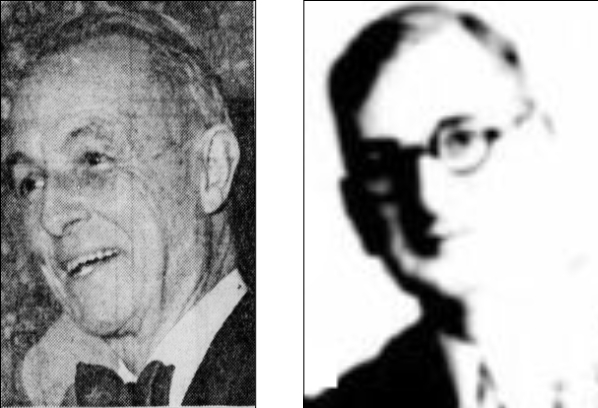
In 1971, Ernest “Ernie” G. [left], referred to in the Big Book (p. 159) as “the devil-may-care chap,” died at the age of 66. Sue wrote, “Ernie never got over [Bonna’s death], and he died two years later to the day…”
In 2016, the Anchorage Dry Dock Club [right],
established in Alaska in March 1982 by Alcoholics Anonymous members “to create a
permanent meeting place for meetings of Alcoholics Anonymous available to
recovering alcoholics in the South Anchorage area,” is officially incorporated
as “The Dry Dock of Anchorage, Inc.” Today,
… the Anchorage Dry Dock operates a social club where recovering alcoholics and addict [sic], their families and friends can spend leisure hours in an alcohol and drug free environment. The Anchorage Dry Dock provides space where groups of Alcoholic Anonymous, Narcotics Anonymous, Al-Anon, Pills Anonymous or any other recovery group can hold meetings.
10 June 2025
June 10 in A.A. History
09 June 2025
June 9 in A.A. History
In 1924, Gardner Fayette Griffith, Bill W.’s maternal grandfather, died in Dorset, Vermont, due to valvular heart disease complicated by rheumatism. He and his wife, Ella A. Brock, began raising Bill and his sister when Bill was 10 years old. Gardner was buried in the East Dorset Cemetery [left: death certificate, gravestone].
Today in A.A. History—June 9–10
* At the time, the chef of the hotel’s swanky Rainbow Room was Ettore “Hector” Boiardi—better known today as Chef Boyardee.
Today in A.A. History—June 9–11
08 June 2025
June 8 in A.A. History
Today in A.A. History—June 8–9
[The 10th Zonal Congress of Alcoholics Anonymous [right] was held in the Colombian city of San José de Cúcuta.]
07 June 2025
June 7 in A.A. History
In 1952, his remains were moved [right: “Irish Tribunal Exhumes Body of Matt Talbot, The Catholic Times, Columbus, Ohio, 11 Jul 1952, p. 3.] to a tomb at Our Lady of Lourdes Church on Seán McDermott Street, Dublin. Although he has not been formally recognized as a saint, he has been declared Venerable and is considered a patron of those struggling with alcoholism. [While not part of Alcoholics Anonymous history, Talbot’s story is noteworthy; by age 28, he was deemed a hopeless alcoholic but “took the pledge” (renounced alcohol) and remained sober for the last 40 years of his life.]
In 1933, James “Jim” R. had his first day of what would become his permanent
sobriety, marking a sobriety date more than 18 months before Bill W.’s.
Continued binge drinking had led Jim to enter The Keswick Colony of Mercy
[left, 1920], a religious recovery mission in New Jersey, where he would remain for the
next 10+ months. He later became a co-founder of Alcoholics Anonymous in
Baltimore, Maryland.


.png)
.png)


.jpg)
.jpg)

.png)
.png)


,%20anonymized.jpg)
.jpg)
.jpg)


.jpg)
.png)
.jpg)
.png)
.png)
.png)


.png)

.png)
.jpeg)
.png)
.png)


.jpg)


.jpg)


,%20p%203.png)
.jpg)