19 December 2024

December 19 in A.A. History

In 1922, Lt. Junius C. and Marjorie Dickerson were married in Pike County, Mississippi. He would become a founder of Alcoholics Anonymous in Jacksonville, Florida.

In 1939, Kaye M., a nonalcoholic, held the first A.A. meeting in Los Angeles, California, at her home on Benecia Street in Westwood.
    Kaye became involved with A.A. earlier in the year while trying to help her ex-husband, Ty, get sober. She visited Akron and New York City, attending meetings and talking with members, including Bill W. in New York. After divorcing Ty and returning to Los Angeles by freighter via the Panama Canal, she began spreading the word about A.A. to newspapers and public officials. She fell in with two other nonalcoholics who were trying to help parolees get and stay sober: Genevieve Dodge, a social worker, and Johnny Howe, a psychologist. They had persuaded the Superior Court to allow them to treat alcoholics at Los Angeles County General Hospital
[below, c. 1931] Kaye taught them A.A. from her experience and from the Big Book, Alcoholics Anonymous, which she had brought with her. Early successes included Barney H. (or B.) and Hal S.
    Then in December, Chuck and Lee T., members of New York City A.A., visited Los Angeles. Bill W. had given them Kaye's number and they looked her up. Kaye decided it was time to have an A.A. meeting in Los Angeles, which was held on this date. Besides Kaye, Johnny Howe and three other social workers, there were Chuck and Lee T., Barney and Ethel H., Hal S., Chauncey and Edna C., Joy S., Dwight S. and Walter K. Kaye telegraphed news of the meeting—“Los Angeles held its first meeting tonight. Fifteen present.”—to Bill W. in New York.


December 18 in A.A. History

In 1917, the U.S. Senate voted 47–8 in favor of a joint resolution to override President Wilson's veto of the Volstead Act; the House had passed the same resolution the day before. The Volstead Act, officially known as the National Prohibition Enforcement Act, would amend the Constitution to prohibit “the manufacture, sale, or transportation of intoxicating liquors within, the importation thereof into, or the exportation thereof from the United States and all territory subject to the jurisdiction thereof for beverage purposes.”* It then went to the 48 states for ratification. On 9 January 1919, Nebraska would become the 36th state to ratify it, and one year later, on 9 January 1920, it would become the 18th Amendment.
*
Note that it did not prohibit consumption, possession, or production for personal use.

In 1934, Bill W. was discharged from Charles B. Towns Hospital for the last time. The charge for his one-week stay was $125 [~$2,945 in 2024], paid in advance by his brother-in-law, Dr. Leonard V. Strong.

In 1952, ector C. wrote to the General Service Office (G.S.O.) in New York City from Buenos Aires, Argentina, asking for help. Hector had been in treatment for alcoholism there since September. His letter immediately sparked a lively and ongoing correspondence, primarily with staff member Ann M., whom Hector came to consider his sponsor. (At one point, Ann M.’s first letter was framed and displayed in Buenos Aires to commemorate the birth of A.A. in Argentina.)

12 June 2024

Supporting A.A. in Ukraine


[Note that this post was written in March 2022, shortly after the full-scale invasion of the Ukraine by the Russian Federation.]

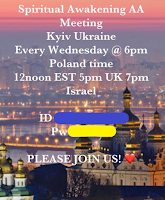
An A.A. friend sent me a very well-done flyer for an online A.A. meeting in Kyiv, Ukraine. It's shown to the left, but I've removed the Meeting ID and Passcode; I don't want to make it that  easy to attend. When I first saw it, I thought, "I only wish that we could do something similar for all the Russian alcoholics, who must also be terribly distressed at this time" (especially those in the Russian military).

This flyer was immediately followed by a less well-done message, shown below, purporting to be from "Ukrainian AA Service Center and the Ukrainian AA Service Board" to "the AA World Community." I was skeptical. This looked so much like a myth that I expected to find it debunked at Snopes ("the internet’s definitive fact-checking resource"). I did not. But I did find an article titled, "UKRAINE: New Crisis, Grimly Familiar Disinformation Trends", which said, in part, 

It is a grim measure of the frequency of crisis events in recent years, and the ubiquity of online disinformation, that when a major story breaks — a terrorist attack, a mass shooting, or an act of war — the writers and editors at Snopes can typically predict what comes next. Recycled videos and photographs, stripped from their proper context, and the same old tropes, all designed to inflame or confuse, or even amuse, the reader.

This is followed by a "grim overview of the familiar disinformation trends and recurring memes… in the opening days of Russia’s invasion of Ukraine."

But, as I said, I only later looked on Snopes. First I searched the Internet. To my surprise, I immediately got a hit that looked very promising. It was on the aa.lviv.ua website and looked like this:


Since I don't know what I presumed was Ukrainian, and not having much patience, I immediately had the page automatically translated into English. It is indeed Ukrainian, and here's the English translation I got:

It was only later that I noticed that an English translation of the message follows the Ukrainian on the original, one click further down. I felt stupid and impatient for not looking.

Ultimately, I decided I'd check into the Kyiv online meeting and see if there was some way I could be helpful. I tried to log in a few minutes before it was to start. Due to the meeting having reached capacity, it was impossible to get in. It then occurred to me, If I'm having this much trouble getting in, there are probably Ukrainians who are also unable to get in. It horrified me to think that I could have had a part in disrupting their meeting. If, by some miracle, I had been able to get in, I sure hope I would have realized that the meeting was at capacity and left. But even if I had, my spot would have been filled by a non-Ukrainian.

I tried joining after the meeting was over. It was bedlam. It appeared that most people were unmuted and there were multiple conversations going on at the same time. I saw one man, who appeared to be that single Ukrainian member. He appeared to be quite stressed out. I also saw some A.A.friends of mine, which was disappointing. I only stayed a minute. The last thing they needed at that point was yet one more non-Ukrainian A.A. to join the fray.

Tonight, I learned from a reliable source that only one of the seven or eight regular Ukrainian group members was able to get into the meeting (presumably, the Zoom host). No doubt, many of the attendees had good intentions, although I'm also pretty sure some did not. Clearly, many also didn't think through the consequences of their actions.

And then, very late last night, My friend said that another friend of hers had found a Facebook post about the A.A. meeting in Kyiv earlier, shown at the left. It was so disheartening to read. Yes, many non-Ukrainians—maybe hundreds of themgot to feel good for a minute. Meanwhile, seven or eight locals never got to their meeting.